
Spontaneous vs. Responsive Desire: The Science of How to Get in the Mood for Sex
In this blog: arousal, desire, getting in the mood, “Come As You Are” by Emily Nagoski
How many times have you sat on the couch, looked at your partner, and thought, “I love them, but I am just completely not in the mood.” I am here to help you answer the question of how to get in the mood for sex.
For decades, pop culture has sold us a very specific picture of sexual desire: a sudden, overwhelming wave of horniness that hits you out of nowhere (usually while you’re doing something mundane like folding laundry). We call this spontaneous desire. And if you don’t experience it regularly, it is incredibly easy to assume that your libido is broken, or that your relationship is on the rocks.
But according to sex educator Dr. Emily Nagoski, the cultural dominance of spontaneous desire is actually grounded in a massive myth: the myth that sex is a biological drive.
If you’ve been wondering how to get in the mood for sex, the secret isn’t waiting for a lightning bolt of random horniness. The secret is understanding the science of spontaneous vs responsive desire, and realizing that for most women, desire is very dependent on context.
Sex is Not a Drive (It’s an Incentive)
We often use the term “sex drive,” but biologically speaking, sex does not function like a drive.
- Drives are things your body requires to survive (like hunger, thirst, and sleep). If you don’t satisfy a drive, you die.
- Incentive Motivation Systems are things your body seeks out to help you thrive.
Drives keep you alive; incentives make life worth living. Sex is an incentive motivation system. This means your brain doesn’t have an internal clock ticking down until you “need” sex. Instead, your brain has a system that turns on when it encounters a high-quality, pleasurable incentive.
Sexual desire isn’t a hunger pang. It’s more of a deep, somatic curiosity.
Spontaneous vs. Responsive Desire: Which One Are You?
In her book Come as You Are, Nagoski breaks down desire into two distinct categories. Understanding which one your nervous system prefers can completely change how you view your sex life.
1. Spontaneous Desire
This is the “classic” model. You are sitting at work, you think of your partner, and boom—you want sex.
- The Goal: The object of desire (your partner).
- The Stats: Roughly 75% of men and 15% of women primarily experience desire this way.
2. Responsive Desire
This is where desire only shows up after sexy things are already happening. You might start out feeling completely neutral or indifferent, but as you begin kissing, touching, or relaxing into the moment, your brain goes, “Oh, right! This feels amazing. I want this.”
- The Goal: The desire itself (the feeling of pleasure).
- The Stats: Roughly 5% of men and 30% of women experience desire this way (with the remaining population experiencing a mix of both).
If you have responsive desire, trying to wait until you are “in the mood” before you start means you might never start. You have to let the pleasure happen first, and let the desire respond to it.

Inside the Female Sexual Response: Brakes vs. Accelerators
To understand how to get in the mood for sex, you have to understand the Dual-Control Model. Your brain has a sexual accelerator (the system that notices “on” switches) and a sexual brake (the system that notices “off” switches like stress, danger, or a messy bedroom).
On average, women’s sexual response systems tend to have more sensitive brakes and less sensitive accelerators. Women are naturally more sensitive to external circumstances and internal emotional states.
Furthermore, many women experience a low level of genital/subjective arousal concordance. This is a fancy therapist term meaning that what your body is doing physically (lubrication, blood flow) doesn’t always automatically match what your brain is feeling emotionally. Because of this, women are much more likely to have context-sensitive, responsive desire.
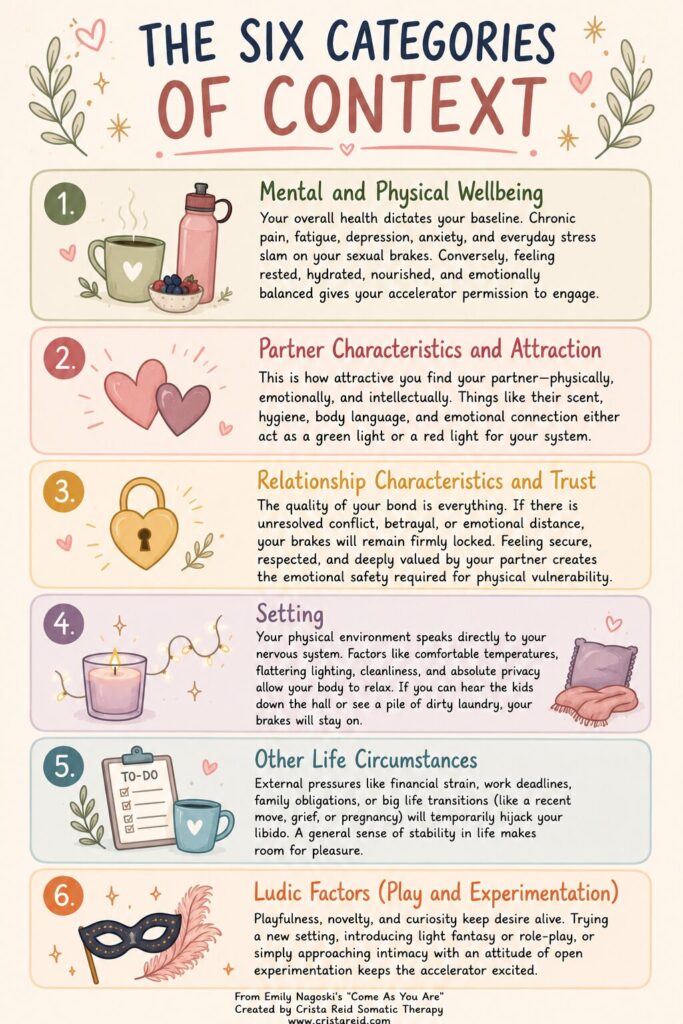
The Six Categories of Context
If desire is context-sensitive, then changing your context is the absolute quickest way to ease your foot off the sexual brake. Nagoski outlines six specific categories of context that dictate whether your brain signals “yes, let’s do this” or “no, danger/stress ahead”:
“How you feel about your sexuality is more important than your sexuality itself.”
Nagoski drops this absolute truth bomb on page 294 of her book. If you carry shame, judgment, or anxiety about your responsive desire, that negative judgment acts as a giant brick on your sexual brake.
These are called meta-emotions, meaning how we feel about our feelings. If you feel broken because you don’t have spontaneous desire, you create a shame-spiral that kills any chance of arousal. Working through lingering emotions like fear, grief, or rage is a vital part of opening up your capacity for pleasure.
Moving From “Fixing” to “Exploring”
You don’t need a higher sex drive. You just need to understand your unique context.
If you are a responsive desire person, stop waiting for the lightning bolt. Instead, focus on creating an environment that feels safe, playful, and relaxing. Take the pressure off the “end goal” of sex, and focus purely on the sensory pleasure of the moment. Your desire will know exactly how to respond.
Ready to Unlock Your Responsive Desire?
If you’re wanting support with this, I offer somatic sex therapy for individuals and couples in Colorado. Together, we can map out your unique accelerators and brakes, untangle any emotional blocks, and help you design a context where your pleasure can naturally thrive.
Book a free consultation here.
References
Nagoski, E. (2015). Come as you are: The surprising new science that will transform your sex life. Simon & Schuster.