

Navigating the “No”: How to Reject an Advance Without Triggering Your Partner
Saying “no” to physical intimacy can feel like walking through an emotional minefield. If you are struggling with how to reject an advance without triggering your partner, you are likely caught between two heavy fears: the fear of compromising your own bodily boundaries, and the fear of sparking conflict or hurting someone you love deeply.
In many relationships, a sexual initiation is rarely just about sex—it is a bid for emotional connection and reassurance. When that bid is turned down abruptly, the initiating partner can feel rejected, unloved, or ashamed, while the declining partner feels pressured, guilty, or overwhelmed.
Learning how to navigate sexual rejection with warmth and clarity is one of the most powerful skills a couple can develop. Because when handled with care, a boundary doesn’t destroy intimacy. It actually protects it.
1. Validating Both Perspectives: The Bid vs. The Boundary
To break out of the cycle of guilt and defensiveness, both partners need to feel seen in their experience:
- The Initiating Partner’s Perspective: Reaching out physically requires vulnerability. When met with a quick or harsh “no,” the brain can interpret that rejection as a statement of worth (“They don’t find me attractive” or “They don’t care about my needs”).
- The Declining Partner’s Perspective: Protecting your physical autonomy is essential. When you are exhausted, stressed, or simply not in the mood, saying “yes” just to keep the peace leads to resentment, somatic bracing, and eventual aversion to touch.
Neither perspective is wrong. One partner is reaching for connection; the other is guarding their current physical or energetic capacity. Recognizing that both feelings are valid allows you to address the moment with empathy rather than defensiveness.
2. “No” Makes Room for “Yes”: Finding the Alternative “Yes”
A “no” to a specific act at a specific time does not have to mean a complete shutdown of emotional connection. One of the gentlest ways to soften a rejection is to ask yourself: “If I am a ‘no’ to this right now, what am I a ‘yes’ to?”
| If you are a “NO” to… | Can you be a “YES” to… |
| Penetrative sex at 10:30 PM when exhausted | 10 minutes of quiet, spooning contact in bed? |
| Immediate sexual touch after a stressful workday | Taking a bath together or a 5-minute shoulder rub? |
| Intimacy right now while your mind is racing | Scheduling a dedicated, pressure-free date morning on the weekend? |
Offering an alternative “yes” validates your partner’s bid for closeness while keeping your physical boundary completely intact. It signals: “I want to be connected to you, even if my body cannot do this specific activity right now.”
3. What If You Are a Full “No” to Everything?
What happens when you are so dysregulated, drained, or overwhelmed that you cannot offer any physical alternative?
It is vital to honor a full, complete “no.”
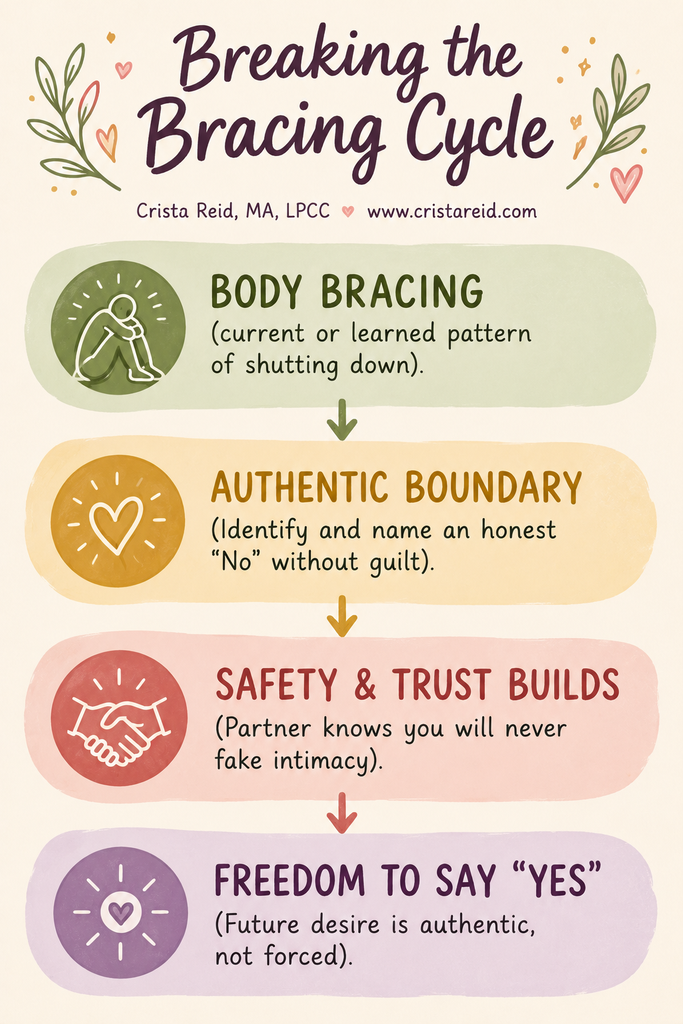
Forcing yourself to perform or offer comfort when your nervous system is screaming “no” breaks trust with yourself. In the long run, fake compliance builds deep resentment that poisons relationship intimacy far more than an honest rejection ever could.
Can you and your partner practice holding an authentic “no” together?
When a relationship develops the capacity to survive a boundary without falling into punishment or withdrawal, something magical happens: trust is built. When your partner knows that your “no” is respected and safe, they can trust with 100% certainty that your future “yes” is genuine, passionate, and real.
4. Challenging Limiting Beliefs & Finding Compromise
Navigating rejection successfully requires dismantling the unhelpful stories we tell ourselves:
- Challenge the Belief: “If they love me, they should always want me.”
- The Reality: Desire is heavily influenced by stress, hormones, sleep, and nervous system state. Rejection is almost always about capacity, not love or attraction.
- Challenge the Belief: “If I say no, I am a bad partner.”
- The Reality: Honoring your internal state is an act of integrity that keeps the relationship safe from chronic resentment.
Practical Tips for Delivering a Warm “No”:
- Lead with affection: “I love you and I love when we connect…”
- State your capacity clearly: “…but my brain and body are completely spent tonight.”
- Reframe the future: “…let’s get a good night’s sleep and cuddle over coffee in the morning.”
Rebuilding Intimacy Through Honesty
A boundary is not a wall designed to keep your partner out—it is a doorway that defines where you end and they begin. Learning to navigate the “no” allows both of you to step into intimacy with freedom, safety, and mutual respect.
If you or your partner are looking for support navigating “no’s” and finding more “yes’s,” somatic therapy can help. It starts with a short conversation. Book your free consult today.
Suggested Next Reads
- Want to navigate desire gaps together in a way that actually brings you closer together? Read What to Do When Your Partner Wants More Sex Than You.
- Struggling to decode your body’s boundaries during touch? Read Why Do I Love My Partner But Don’t Want to Have Sex With Them?.